 23
23max amplitude of the resultant standing wave will be 2A and not A ,
A is the amp of the waves that interfered to giv this standing wave
btw how did u find wavelength ?
 1
1Lol...you are replying after so long
I got the answer anyways.
Hmm wavelength....nice question.
look, the distance between two points is given as 15cm.
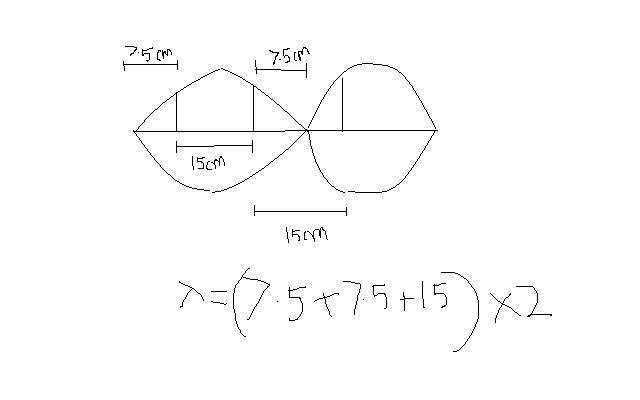
Draw a figure with two waves.
take 3 vertical lines with amplitude 3.5mm (there are total 4 actually - take first 3)
The distance between 2nd and 3rd line is 15cm. Half of it will give the distance between 2nd line and the node- whicch is 7.5cm.
Now the distance between first and second line is 15cm again. So half of wavelength is 15 + 7.5*2 = 30cm
Total wavelength is 60cm.
23
qwerty
·2010-11-21 19:13:04
arey but why 2 waves ? i m not getting how did u decide wich harmonic frequency it is ????
1
swordfish
·2010-11-22 02:03:10
arey why do you want to know which frequenccy....woh toh baad ki baat.....
you need 2 waves to just understand and derive what is wavelength.....wich harmonic frequency it is doesnot matter......
23
qwerty
·2010-11-22 02:17:39
arey if it is fundamental frequency then 2λ =L
if it is first harmonic then λ = L
if it is nth harmonic then λ = nL /2
ur lambda very much depends on it
1
swordfish
·2010-11-22 03:29:31
mere bhai......string ki length dekho.....120cm....aur 2 displacements of string are 15cm apart......toh aise bohot sare waves honge (greater than 2 waves offcourse).
So just take 2 waves first....then find wavelength.....phir kitne harmonics hain woh toh is formulae se
λ = nL /2
I think you did not understand how I am finding wavelength....I am NOT using this formula for finding wavelength....just by drawing figure with 2 waves and finding out logically.
23
qwerty
·2010-11-22 03:43:02
oh okk okk got it !! nicely done !
never thought it dat way ... sorry for wasting ur time though [4] !!!